

If you are facing a terminal diagnosis and carrying a life insurance policy, a viatical settlement may be one of the most significant financial options available to you right now. Yet most policyholders have never heard the term, and many who have assume it applies to someone else. The reality is that selling your life insurance policy to a third-party buyer can deliver immediate cash, eliminate ongoing premium payments, and provide financial flexibility precisely when you need it most. This guide explains how viatical settlements work, how they compare to other options, and what to consider before moving forward.
Table of Contents
-
Viatical vs. life settlements, surrender value, and accelerated death benefits
-
My perspective on viatical settlements and financial planning
-
How Accelerated Life Solutions can help you explore your options
Key takeaways
| Point | Details |
|---|---|
| Viatical settlements pay more than surrender | Sellers typically receive 50% to 80% of face value, far above cash surrender value. |
| Terminal illness is the primary qualifier | Life expectancy of 24 months or less is the standard eligibility threshold for a viatical settlement. |
| Tax treatment is often favorable | Proceeds for terminally ill individuals are generally tax-free, unlike most life settlement proceeds. |
| Multiple options exist for policy liquidity | Viatical settlements, life settlements, and accelerated death benefits each serve different situations. |
| Licensed brokers protect your interests | Working with a licensed broker helps you obtain competitive offers and avoid predatory pricing. |
What a viatical settlement is and how it works
A viatical settlement is the sale of a life insurance policy by a terminally or chronically ill policyholder to a third-party buyer in exchange for a lump sum cash payment. The buyer, typically an institutional investor or a settlement provider, pays you now, takes over the premium payments, and collects the death benefit when the policy matures. You receive cash you can use immediately, for medical care, living expenses, or any other purpose.
The definition of viatical comes from the Latin word viaticum, meaning provisions for a journey. In financial terms, it refers to converting a future death benefit into present-day liquidity for someone facing a shortened life expectancy. The term has a specific legal meaning in most states, and it is distinct from a life settlement, which applies to policyholders who are not terminally ill.
How the transaction works in practice:
-
You submit your policy details and medical records to a licensed viatical settlement broker or provider
-
The buyer evaluates the policy’s face value, your life expectancy, and the cost of future premiums
-
You receive a lump sum offer, typically between 50% and 80% of face value depending on life expectancy and policy terms
-
Ownership and beneficiary designation transfer to the buyer at closing
-
The buyer assumes all future premium obligations
Eligibility centers on health status. Life expectancy of 24 months or less is the standard threshold for a viatical settlement, though some providers work with individuals whose prognosis extends slightly beyond that window. Whole life, universal life, and some convertible term policies typically qualify. Group life policies may qualify in certain circumstances, depending on portability provisions.
Pro Tip: Request your policy’s in-force illustration before approaching any settlement provider. This document shows the current cash value, projected premium obligations, and death benefit, and it gives buyers the data they need to make a competitive offer.
Viatical vs. life settlements, surrender value, and accelerated death benefits
Understanding the differences between these options is critical before making any decision. The terms are often used loosely, but they carry distinct meanings with real financial consequences.
A viatical settlement applies to terminally or chronically ill individuals. A life settlement applies to policyholders who are older, often 65 or above, but not necessarily facing terminal illness. Both involve selling the policy on the secondary market, but viatical and life settlements differ significantly in eligibility, timing, and tax treatment. Consumers should not assume the terms are interchangeable.
Accelerated death benefits (ADBs) are a separate option entirely. These are provided by the insurance company itself, not a third-party buyer, and allow you to access a portion of your death benefit early if you meet the insurer’s criteria for terminal illness. ADBs are faster to access but typically deliver a smaller percentage of the face value than a viatical settlement would.
The comparison table below outlines the key distinctions:
| Option | Eligibility | Payout as % of face value | Tax treatment | Who pays premiums after |
|---|---|---|---|---|
| Viatical settlement | Terminal/chronic illness, typically 24 months or less | 50% to 80% | Generally tax-free for terminally ill | Third-party buyer |
| Life settlement | Typically age 65+, longer life expectancy | 10% to 40% | Partially taxable | Third-party buyer |
| Cash surrender | Any policyholder | Cash value only (often 10% to 30%) | Gains above basis are taxable | Policy ends |
| Accelerated death benefit | Terminal illness per insurer criteria | 25% to 90% (varies by policy) | Generally tax-free | Policyholder (reduced benefit) |
The life settlement offer versus surrender value comparison is where most policyholders are surprised. Sellers receive on average 6.5 times more from secondary market sales compared to cash surrender value. That gap is not a rounding error. It reflects the fact that the secondary market prices the policy based on its death benefit and projected holding period, not on the insurer’s internal accounting of accumulated cash value.

The life settlement market price is based on the present value of the death benefit discounted by expected life expectancy and premium costs. Cash surrender value reflects none of that. For a terminally ill policyholder, the life settlement versus policy surrender comparison almost always favors the settlement, often by a substantial margin.
Pro Tip: If your policy has a low cash value but a significant death benefit, the gap between surrender value and a viatical settlement offer will likely be largest. Policies with high face values and shorter life expectancies attract the most competitive bids from buyers.
Benefits and risks of viatical settlements
Viatical settlements offer real financial advantages, but they also carry trade-offs that deserve careful consideration.
Primary benefits include:
-
Immediate liquidity. You receive a lump sum that can be used for medical expenses, home care, debt repayment, or any personal need without restriction.
-
Premium relief. Once the policy transfers, you are no longer responsible for premium payments, which can be a significant monthly burden.
-
Higher payout than surrender. As noted, selling on the secondary market can yield 4 to 7 times more than surrendering the policy to the insurer.
-
Favorable tax treatment. Viatical proceeds for terminally ill individuals are generally tax-free under federal law, which is a meaningful advantage over most life settlement transactions.
Risks and considerations to weigh:
-
Loss of death benefit. Your named beneficiaries will no longer receive the policy’s payout. This is the most significant trade-off and requires honest family communication.
-
Impact on public assistance. A lump sum payment may affect eligibility for Medicaid or other needs-based programs. Consulting with a benefits counselor before closing is advisable.
-
Privacy concerns. The transaction requires sharing detailed medical and financial information. Reputable providers use confidentiality agreements and secure data practices.
-
Regulatory variability. The viatical settlement market is regulated in 43 states with disclosure and licensing requirements, but protections vary. Verifying that any provider or broker holds a current state license is a basic but critical step.
Many policyholders focus on what they are giving up rather than what they are gaining. For someone facing a terminal diagnosis with mounting medical costs and ongoing premium obligations, a viatical settlement can convert a future-focused asset into present-day financial stability. That is a meaningful shift in how the policy serves you.
Working with a licensed broker, rather than approaching a single provider directly, is strongly recommended. Brokers submit your policy to multiple buyers, which generates competitive bidding and typically results in a higher offer. The secondary market for life insurance remains vastly underutilized, in part because many financial advisors do not proactively raise this option with clients. You may need to ask.
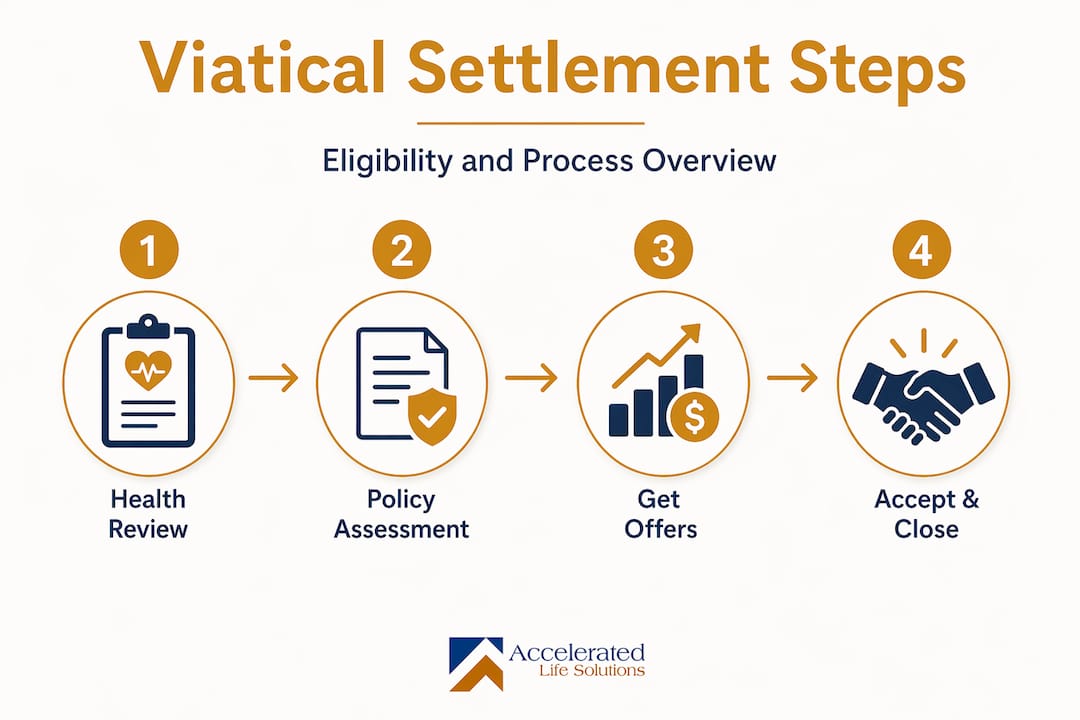
The viatical settlement process, step by step
Understanding what to expect at each stage reduces uncertainty and helps you make decisions with confidence. Viatical transactions often move faster than traditional life settlements due to the urgency of terminal illness and the shorter expected holding period for investors.
-
Gather your policy documents. Collect your policy contract, the most recent in-force illustration, premium payment history, and any existing loan balances against the policy.
-
Obtain medical records. Buyers will require documentation of your diagnosis, treatment history, and physician-certified life expectancy. Your broker will guide you on what is needed.
-
Engage a licensed broker. A broker submits your case to multiple licensed buyers simultaneously. This competitive process is how you maximize the offer you receive. Review the broker’s licensing status and fee structure before signing any agreement.
-
Review offers carefully. Compare not just the dollar amounts but the terms, closing timelines, and any contingencies. Your broker should explain each offer in plain language.
-
Understand escrow and closing. Reputable transactions use escrow accounts to hold funds during the transfer of ownership. Transparency in broker fees, escrow practices, and buyer licensing are critical safeguards that protect you from potential abuses.
-
Close the transaction. Once documents are signed and ownership transfers, funds are released from escrow to you. The buyer notifies the insurance company of the ownership change.
-
Plan for post-settlement considerations. Consult a tax advisor to confirm your specific tax treatment. Notify family members who were named as beneficiaries. If you receive public benefits, speak with a benefits specialist before the funds arrive.
Pro Tip: Ask any broker you consider working with these three questions: Are you licensed in my state? Do you represent buyers or sellers? How are you compensated? A broker who represents sellers and earns a percentage of the settlement has aligned incentives with you. One who earns fees from buyers does not.
You can also review common seller mistakes before you begin the process. Knowing what to avoid is as valuable as knowing what to do.
My perspective on viatical settlements and financial planning
I have worked in the life settlement sector long enough to see a consistent pattern. Terminally ill policyholders often arrive at this conversation late, sometimes after they have already surrendered a policy or let it lapse. The financial loss in those situations is real and, in most cases, entirely avoidable.
What I have found is that the barrier is rarely complexity. The viatical settlement process is not difficult to understand. The barrier is awareness. Many advisors do not raise this option, either because they are unfamiliar with it or because they do not see it as part of their scope. That fiduciary gap leaves significant value untapped for people who need it most.
I also want to be direct about the emotional dimension. Deciding to sell a life insurance policy is not a neutral financial transaction for most people. It involves rethinking what that policy was meant to do, and having honest conversations with family members about changed circumstances. That is not easy. But in my experience, the policyholders who engage this process thoughtfully, with good professional support, consistently report that the financial relief was worth it.
My caution is this: do not rush, and do not go it alone. The secondary market is competitive, but only if you access it through a broker who shops your policy to multiple buyers. A single direct offer from one provider is rarely the best you can do. Take the time to understand your options, verify licensing, and ask questions until you are satisfied with the answers.
— Brian Hurley
How Accelerated Life Solutions can help you explore your options

Accelerated Life Solutions works exclusively as a seller-side broker, which means the firm’s only obligation is to the policyholder. If you are considering a viatical settlement, Accelerated Life Solutions will submit your policy to multiple licensed buyers, manage the competitive bidding process, and provide clear, compliant guidance at every stage. There are no upfront fees, and your privacy is protected throughout. To get a quick sense of what your policy may be worth, start with the settlement value calculator on the Accelerated Life Solutions website. For a personalized consultation, visit the life settlements broker page to learn more about the firm’s process and reach out directly. Accelerated Life Solutions is licensed, independent, and focused entirely on maximizing the value you receive.
FAQ
What does viatical mean in financial terms?
The definition of viatical refers to the sale of a life insurance policy by a terminally or chronically ill individual to a third-party buyer in exchange for a lump sum payment below the face value but above the cash surrender value.
How is a viatical settlement different from a life settlement?
A viatical settlement applies to policyholders with a terminal or chronic illness, typically with a life expectancy of 24 months or less, while a life settlement applies to older policyholders who are not facing terminal illness. The two also differ in tax treatment and typical payout percentages.
Are viatical settlement proceeds taxable?
For terminally ill individuals, viatical settlement proceeds are generally tax-free under federal law. However, tax outcomes can vary based on the specific transaction structure, so consulting a tax advisor before closing is recommended.
How much can I receive from a viatical settlement?
Payouts typically range from 50% to 80% of the policy’s face value, depending on life expectancy, policy type, and the competitive bidding environment. This is substantially more than most policies’ cash surrender value.
What happens to my beneficiaries if I complete a viatical settlement?
Once the policy transfers to the buyer, your named beneficiaries no longer have a claim to the death benefit. The buyer becomes the new owner and sole beneficiary. This is the primary trade-off to discuss with family members before proceeding.