

Funding long-term care via life settlement is defined as selling an existing life insurance policy to a third-party investor for a lump-sum payment, then directing those proceeds toward care expenses. The average 65-year-old needs $135,000 set aside for long-term care, with women potentially facing costs exceeding $665,000 over multiple years. That scale of need makes a life insurance policy one of the most underutilized assets in a senior’s financial plan. This guide explains how the life settlement process works, how it compares to other funding options, and what financial and Medicaid planning steps protect your interests throughout.
What is a life settlement and how does it fund long-term care?
A life settlement is the sale of an existing life insurance policy to a third party for a lump-sum payment that exceeds the policy’s cash surrender value but falls below the full death benefit. The buyer assumes all future premium payments and becomes the new beneficiary. The original policyholder receives cash that can be used immediately, including for long-term care expenses such as home health aides, assisted living, or memory care.
The financial difference between surrendering a policy and selling it through a life settlement is significant. Surrendering returns only the accumulated cash value, which may be a fraction of what a third-party buyer would pay. The life settlement market is estimated at $224 billion annually in eligible policies, yet most are surrendered or lapsed without ever being offered to the market. That gap represents real money left unclaimed by seniors who needed it most.

Who typically qualifies for a life settlement?
Qualification depends on several factors that investors use to assess policy value:
-
Age and health status: Most buyers target policyholders aged 65 and older, particularly those with a change in health since the policy was issued.
-
Policy type and size: Universal life, whole life, and convertible term policies with face values of $100,000 or more are the most commonly accepted.
-
Premium affordability: Policies where premiums have become a financial burden are strong candidates, since the buyer takes over those payments.
-
Beneficiary circumstances: If the original need for the death benefit has changed, such as children who are now financially independent, the policy may no longer serve its intended purpose.
Pro Tip: Before contacting your insurance carrier about surrendering a policy, request a life settlement eligibility assessment first. A competitive bidding process through a licensed broker can reveal an offer substantially higher than the surrender value, with no out-of-pocket cost to you.
How does funding long-term care via life settlement compare to other options?
Long-term care funding options include traditional LTC insurance, hybrid life/LTC policies, hybrid annuities with LTC riders, life settlements, and self-funding. Each carries different cost structures, payout timing, and eligibility requirements. The right choice depends on your care setting, expected duration, and current assets.
| Funding option | How it works | Key advantage | Key limitation |
|---|---|---|---|
| Life settlement | Sell policy for lump sum | Immediate cash, no premiums owed | Heirs lose death benefit |
| Hybrid life/LTC policy | Life insurance with LTC rider | Dual-purpose coverage | Requires new premiums or lump-sum purchase |
| Traditional LTC insurance | Standalone policy for care costs | Defined benefit for care | High premiums, use-it-or-lose-it structure |
| 1035 exchange | Tax-free swap into hybrid policy | Preserves tax basis | Limited by policy type and health |
| Self-funding | Draw from savings or investments | Full control | Depletes retirement assets quickly |
| Medicaid | Government program for low-income | Covers broad care costs | Strict asset limits around $2,000 |
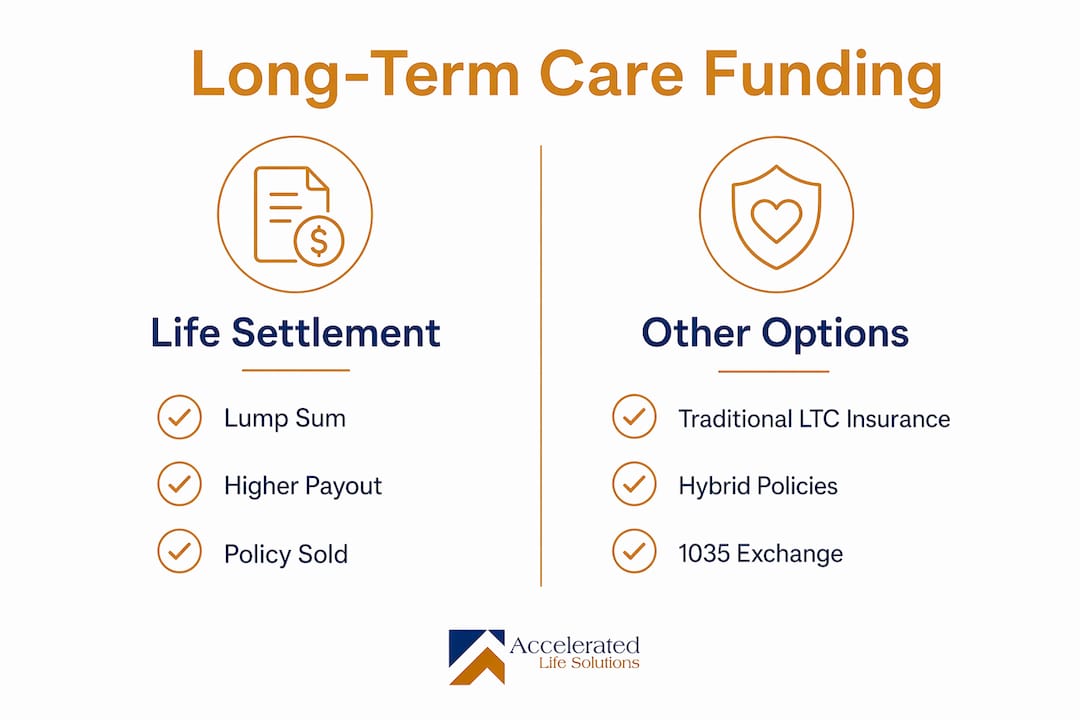
A 1035 exchange allows a tax-free conversion of an existing life insurance policy into a hybrid LTC product, which preserves the tax basis while adding care coverage. This option works well for policyholders in good health who want ongoing coverage rather than a lump sum. However, it requires the policy to meet specific qualification criteria and does not generate immediate cash.
Life settlements stand apart because they convert a static asset into liquid capital without requiring the policyholder to purchase anything new. For seniors already facing care costs or expecting them within one to three years, the immediacy of a lump sum is a practical advantage that hybrid products cannot match.
Step-by-step process to access long-term care funding via a life settlement
Completing a life settlement takes between 30 and 90 days from initial assessment to funded proceeds. The process is structured, but each step requires deliberate attention to protect your financial outcome.
-
Assess policy eligibility. Gather your policy documents, including the face value, type, premium schedule, and any existing cash surrender value. A licensed life settlement broker can conduct a preliminary review at no cost.
-
Engage a licensed broker. Brokers submit your policy to multiple institutional buyers simultaneously, generating competitive bids. Fees are paid from the proceeds, not out of pocket. Use the life settlement calculator at Accelerated Life Solutions to get a preliminary estimate before engaging.
-
Obtain and compare multiple offers. Never accept the first offer. The spread between the lowest and highest bid can be substantial, and requesting multiple offers is the single most effective way to maximize proceeds.
-
Complete medical and policy underwriting. Buyers will request medical records and policy illustrations. This step is standard and does not affect your health insurance or other coverage.
-
Review and sign the purchase agreement. Confirm the net proceeds after broker fees, understand the transfer of beneficiary rights, and verify the escrow arrangement for fund disbursement.
-
Receive proceeds and direct to care funding. Once the policy transfer is recorded, proceeds are released from escrow. You can direct funds to a care facility, home health agency, or a dedicated care account.
Pro Tip: Never sign surrender paperwork with your insurance carrier until you have received and reviewed life settlement offers. Once a policy is surrendered, the opportunity to sell it on the secondary market is permanently lost.
A best practice among financial advisors is to conduct a life settlement eligibility check before any surrender paperwork is signed, using competitive bidding to maximize proceeds while preserving fiduciary obligations. Seniors working with an estate attorney or financial planner should request this check as a standard step in any policy review.
Financial and Medicaid planning considerations when using life settlements for care funding
Medicaid uses strict countable resource limits, typically around $2,000 per individual, to determine eligibility for long-term care benefits. A life settlement lump sum counts as a countable asset the moment it is received, which can disqualify a senior who was otherwise eligible or close to eligible. This does not mean life settlements are incompatible with Medicaid planning. It means the timing and spend-down strategy must be planned carefully before the transaction closes.
Key planning considerations include:
-
Model the Medicaid impact before closing. Work with a Medicaid planning attorney or elder law specialist to project how the lump sum affects your asset total and eligibility window.
-
Plan the spend-down deliberately. Proceeds spent on qualifying care expenses, such as home modifications, medical equipment, or prepaid funeral arrangements, can reduce countable assets without triggering penalties.
-
Understand state variability. Medicaid rules differ by state, and some states apply different asset limits or exemption categories. What applies in Florida may not apply in California or Texas.
-
Avoid improper timing. Seniors who receive a large lump sum and apply for Medicaid shortly after may face a disqualification period. Improperly timed lump sums can cause disqualification during critical application windows.
-
Coordinate with your full financial picture. Life settlement proceeds interact with Social Security, pension income, and other assets. A holistic review prevents unintended consequences across benefit programs.
Medicaid planning risk is a key caution for seniors. Even a large life settlement lump sum can complicate eligibility, so personalized modeling and timing are critical for protecting resources. Working with both a life settlement broker and an elder law attorney before closing is the most reliable way to protect eligibility while maximizing care funding.
Common mistakes when funding long-term care with life settlements
Several recurring errors reduce the financial benefit of a life settlement or create planning complications that could have been avoided.
-
Surrendering the policy without exploring the secondary market. This is the most costly mistake. The life settlement market is estimated at $224 billion in eligible policies annually, yet most are lapsed or surrendered. Surrendering without a settlement check leaves significant value unclaimed.
-
Accepting a single offer. One offer is not a market. Competitive bidding among multiple institutional buyers consistently produces higher proceeds.
-
Ignoring Medicaid implications. Receiving a lump sum without planning the spend-down can disqualify a senior from Medicaid benefits at exactly the moment care costs are highest.
-
Overestimating how far proceeds will stretch. A $150,000 settlement sounds substantial, but memory care facilities in major metro areas can cost $7,000 to $10,000 per month. Proceeds must be coordinated with other funding sources, not treated as a standalone solution.
-
Misunderstanding tax treatment. Life settlement proceeds are not entirely tax-free. The portion above the policy’s cost basis is taxable as ordinary income or capital gain, depending on the holding period. A tax advisor should review the transaction before closing.
-
Failing to disclose the settlement to heirs. The death benefit transfers to the buyer. Beneficiaries who are unaware of the transaction may have incorrect expectations about the estate. Clear communication prevents family conflict.
Key takeaways
Funding long-term care via life settlement converts an existing life insurance policy into immediate cash, typically exceeding the surrender value, and requires careful Medicaid and tax planning to maximize the benefit.
| Point | Details |
|---|---|
| Life settlement vs. surrender | A life settlement pays more than the cash surrender value; never surrender without a secondary market check. |
| Medicaid timing risk | A lump sum counts as a countable asset; model the Medicaid impact before the transaction closes. |
| Multiple offers matter | Competitive bidding among buyers consistently produces higher proceeds than a single offer. |
| Tax implications | Proceeds above the policy’s cost basis are taxable; consult a tax advisor before closing. |
| Care cost scale | Average long-term care needs reach $135,000 for men and can exceed $665,000 for women over multiple years. |
What I’ve learned from watching seniors navigate this decision
From my experience working with seniors and their families on life settlement transactions, the most consistent pattern I see is not financial. It is emotional. Families delay the conversation because selling a life insurance policy feels like giving something up. The death benefit was meant for the children or the spouse. Letting it go, even for a fair price, carries weight that a spreadsheet does not capture.
What I have found is that the families who approach this decision proactively, before a care crisis forces their hand, almost always get better outcomes. They have time to obtain multiple offers, model the Medicaid impact, and coordinate with their estate attorney. The families who call after a parent has already been placed in memory care are working against the clock, and that urgency costs them negotiating leverage.
The other thing I would emphasize is that many financial advisors never raise life settlements with clients, not out of negligence, but simply because it was not part of their training. If your advisor has not reviewed your existing policies for settlement potential in the last two years, ask them to. A policy that no longer fits your needs or has become a premium burden may be worth far more on the secondary market than you expect. That conversation costs nothing and could change your care options significantly.
— Brian Hurley
How Accelerated Life Solutions helps seniors fund long-term care
Seniors and their families deserve a clear, competitive process when evaluating life settlement options. Accelerated Life Solutions operates as an independent broker, submitting policies to multiple institutional buyers to generate competitive offers with no upfront cost to the policyholder.

Start with the life settlement calculator at Accelerated Life Solutions to get a preliminary estimate of your policy’s market value. From there, the team at Accelerated Life Solutions guides you through underwriting, offer comparison, and closing, with full transparency on broker fees and net proceeds. For families coordinating care funding across multiple assets, the life settlement brokerage services at Accelerated Life Solutions provide the structured, compliant process that protects both the policyholder and their advisors throughout the transaction.
FAQ
What is a life settlement used for in long-term care planning?
A life settlement converts a life insurance policy into a lump-sum payment that can be directed toward assisted living, home health care, memory care, or other long-term care expenses. The proceeds are unrestricted and available immediately after the transaction closes.
How long does the life settlement process take?
The life settlement process typically takes 30 to 90 days from initial eligibility assessment to funded proceeds, depending on the complexity of the policy and the speed of medical underwriting.
Does a life settlement affect Medicaid eligibility?
Yes. The lump sum received from a life settlement counts as a countable asset under Medicaid, which can affect eligibility. Seniors should work with an elder law attorney to plan the spend-down before the transaction closes.
Is a life settlement taxable?
The portion of life settlement proceeds that exceeds the policy’s cost basis is taxable, either as ordinary income or capital gain. A tax advisor should review the transaction structure before closing to minimize the tax impact.
What policies qualify for a life settlement?
Universal life, whole life, and convertible term policies with face values of $100,000 or more are the most commonly accepted. Policyholders are typically 65 or older, and a change in health since the policy was issued generally increases the policy’s market value.