

When advising clients on life settlement options, many financial advisors assume that going directly to a buyer is simpler, faster, and equally effective. That assumption costs clients money. The life settlement broker vs direct buyer question is one of the most consequential decisions in the settlement process, and the differences go well beyond convenience. This guide breaks down how each channel works, the financial and ethical implications of each path, and the specific factors that should shape your recommendation for each client.
Table of Contents
Key takeaways
| Point | Details |
|---|---|
| Brokers create competition | Shopping a policy to multiple buyers drives up offers, often producing significantly higher net proceeds. |
| Direct buyers move faster | A single-offer process is quicker but sacrifices price discovery that benefits most sellers. |
| Fiduciary duty differs | Licensed brokers are legally obligated to act in the client’s interest; direct buyers are not. |
| Commissions require context | Broker fees reduce gross offers, but competitive bidding typically more than offsets that cost. |
| Verification protects clients | Confirming licensure and association membership is a baseline due diligence step before any engagement. |
Life settlement broker vs direct buyer: how each role works
A life settlement is the sale of an existing life insurance policy by the original policyowner to a third party for a lump sum that exceeds the cash surrender value but is less than the death benefit. The buyer assumes responsibility for future premium payments and collects the death benefit when the insured passes. For clients holding policies they no longer need or can afford, this can be a meaningful source of liquidity.
Two distinct parties can facilitate or execute that transaction: a life settlement broker and a direct buyer (also called a life settlement provider).
What a life settlement broker does:
-
Represents the policy seller exclusively
-
Submits the policy to multiple buyers in the secondary market to generate competing offers
-
Handles underwriting submissions, negotiation, and closing documentation
-
Earns a commission on the gross sale price, paid at closing
-
Must hold a state-issued broker license in most jurisdictions
What a direct buyer does:
-
Purchases the policy directly using their own funds or institutional capital
-
Provides a single offer based on internal underwriting models
-
Controls the process from submission through closing
-
Earns profit from the spread between purchase price and eventual death benefit
-
Must hold a provider license in states where they operate
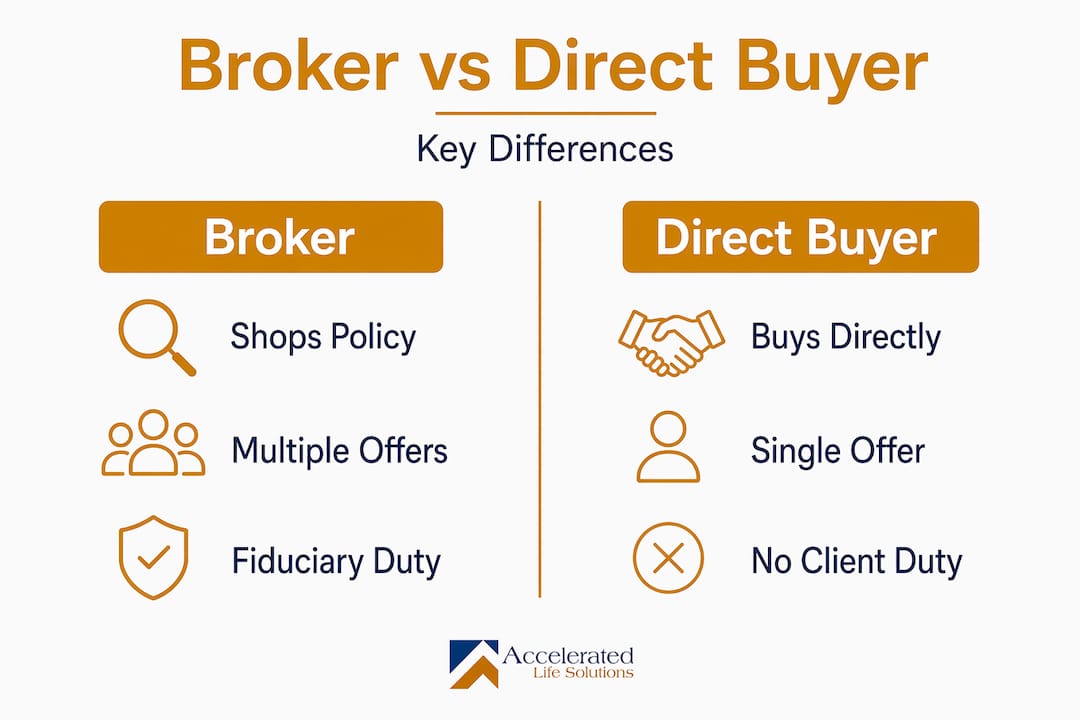
According to industry standard practice, brokers shop policies to multiple buyers to generate competition and multiple bids, while direct buyers provide a single offer based on internal underwriting. The procedural difference is straightforward. The financial difference is where advisors need to pay attention.
Licensing and regulatory oversight vary by state, but most jurisdictions require both brokers and providers to register with the state insurance department. The Life Insurance Settlement Association (LISA) maintains voluntary membership standards that complement statutory requirements. Timelines across both channels generally run 60 to 120 days from submission to funding, though direct buyers can sometimes close faster with less complex policies.
Economic outcomes: brokers vs direct buyers
The financial case for working with a broker typically comes down to one word: competition. When a policy is submitted to multiple buyers simultaneously, each buyer knows they are competing. That awareness alone changes offer behavior.
Life settlement offerings range from 10% to 40% of the death benefit for traditional settlements and from 50% to 80% for viatical settlements, depending on health, age, and policy type. Within that range, the spread between the lowest and highest offer on any given policy can be substantial. A single direct buyer captures only one point in that range. A broker working a competitive process tries to find the top of it.
The data supports this. Consumers who sold through LISA member brokers received nearly nine times their cash surrender value in 2025. That figure reflects what market competition produces when a policy is properly positioned and submitted broadly.

Comparing the two channels
| Factor | Life settlement broker | Direct buyer |
|---|---|---|
| Number of offers | Multiple (competitive bidding) | Single offer |
| Price discovery | High | Low |
| Closing speed | 60 to 120 days (typical) | Often faster |
| Net payout potential | Higher on average | Lower on average |
| Seller representation | Yes, fiduciary duty | No |
| Commission cost | Yes, deducted from gross | None to seller |
| Transparency of process | High (multi-party) | Varies |
Broker commissions vary by state and transaction type, reducing the gross offer by a percentage. The critical question for advisors is not whether a commission exists, but whether the competitive process generates enough additional value to cover it. In most cases, especially for larger policies or clients with impaired health, it does.
Pro Tip: When presenting settlement options to clients, request a net proceeds illustration from any broker you engage. Compare that figure to direct buyer offers after all fees. The commission becomes a non-issue when the net number is materially higher.
Direct buyers are not always the wrong answer. For clients who need liquidity quickly, hold simpler policies, or have already received multiple independent quotes, a direct buyer can provide a clean, fast close. The problem arises when clients go directly to buyers as a default, without understanding what they may be leaving on the table.
Fiduciary responsibilities and ethical considerations
This is the section most advisors need to sit with carefully. The question of whom each party legally represents defines the entire risk profile of the transaction.
Licensed life settlement brokers carry a fiduciary obligation to act in the client’s best interest. That means they are legally required to prioritize the seller’s outcome over their own compensation or any buyer relationship. Direct buyers, by contrast, pursue their own financial return. They have no legal duty to disclose competing offers, no obligation to maximize the seller’s proceeds, and no incentive to inform a client that a higher offer might exist elsewhere.
For advisors with their own fiduciary obligations, that asymmetry matters. Recommending a direct buyer path without ensuring adequate market exposure could expose you to questions about whether your client received fair value. The Financial Advisor’s Guide to Life Settlements from Accelerated Life Solutions outlines how advisors can document their due diligence process to protect both clients and themselves.
Before recommending any broker or direct buyer, advisors should verify the following:
-
Confirm the entity holds a current, state-issued license (broker or provider, as applicable)
-
Check for active membership in LISA or comparable industry associations
-
Review any disciplinary history through the state insurance department
-
Request a written disclosure of all fees, commissions, and compensation arrangements
-
Obtain documentation confirming the seller has received independent review of alternatives
Verifying licensure status and checking industry association membership are recognized consumer protection best practices. The same standard applies when advisors are evaluating partners for their clients.
Pro Tip: Always request a signed disclosure from any life settlement professional confirming their license number, state of licensure, and how they are compensated. This single document protects your client and creates a clear record of your due diligence.
When to recommend a broker vs a direct buyer
Not every client is the same, and neither is every policy. The right recommendation depends on a careful assessment of the client’s circumstances, objectives, and timeline.
Consider using a life settlement broker when:
-
The client’s primary goal is maximizing net proceeds, and speed is secondary.
-
The policy has a face value above $500,000, where buyer variation tends to be largest.
-
The insured has moderate to significant health impairment, making life expectancy a competitive underwriting factor.
-
The client is not under acute financial pressure and can allow a 90 to 120 day process.
-
The policy type is complex (universal life, variable life) and may attract varying valuations across buyers.
Consider a direct buyer when:
-
The client has an urgent liquidity need and timeline is the overriding constraint.
-
The policy is relatively small or straightforward, limiting upside from competitive bidding.
-
The client has already received multiple independent quotes and wants to execute quickly with a known party.
-
The broker market has already been tested and a direct offer represents a legitimate top-of-market figure.
Checklist questions advisors should ask before making a recommendation:
-
What is the client’s primary objective: maximum proceeds or speed?
-
What is the policy’s face value and current cash surrender value?
-
Does the insured have any health conditions that could improve valuation?
-
What is the client’s premium payment capacity if the process extends 90 or more days?
-
Has the client received any prior offers, and from whom?
-
Does the advisor have a fiduciary obligation that requires documented market exposure?
The life expectancy role in settlements is another variable that shifts the broker advantage significantly. Policies where the insured’s health has declined since issuance are precisely the cases where buyers diverge most on valuation, and where competitive bidding adds the most value.
Risks and pitfalls advisors must watch for
Even when advisors understand the broker vs direct buyer distinction, execution errors can still compromise outcomes. These are the most common mistakes that affect client results.
Warning signs and pitfalls to watch for:
-
Opaque direct buyer offers: A buyer that cannot explain how the offer was calculated or refuses to provide a written breakdown of all deductions should raise concerns.
-
Unlicensed providers: Operating without a state license is illegal in most jurisdictions and leaves the client with no regulatory recourse.
-
Undisclosed commission structures: Some brokers bury fees or use net offer framing that obscures total compensation. Require full disclosure before any client commits.
-
Ignoring estate implications: Life settlement proceeds may affect estate planning, Medicaid eligibility, or trust structures. Coordinate with estate counsel before closing.
-
Pressure to close quickly: Legitimate buyers and brokers understand that clients need time to evaluate. Urgency tactics from any party should prompt additional scrutiny.
-
No competitive process documentation: If a broker cannot show you that the policy was submitted to multiple buyers, the competitive advantage of using a broker has not been realized.
The risks of unrepresented sellers in direct transactions appear consistently in settlement outcomes. Clients who go directly to buyers without broker representation routinely accept offers below what a competitive process would have produced.
My perspective on getting this right
I’ve spent years working with financial advisors on life settlement cases, and the pattern I see most often is not malice. It’s incomplete information. Advisors recommend direct buyers because they seem simpler, or because a buyer reached out first, or because they haven’t had a chance to compare outcomes across cases.
What I’ve seen in practice is that the broker advantage is most pronounced exactly where advisors underestimate it. A 74-year-old client with a $1.2 million universal life policy and a cardiac history does not look like a compelling settlement candidate on paper. But submitted to a competitive market, that policy can draw meaningfully different bids depending on how each buyer models life expectancy. I’ve watched competitive processes produce final offers 30% to 40% higher than the first direct buyer quote the client received.
The fiduciary dimension is what I think deserves more attention. Advisors have their own legal and ethical obligations. Recommending a channel that forgoes market competition without documented rationale puts both the client’s outcome and the advisor’s practice at risk. The choosing a settlement representative guidance published by Accelerated Life Solutions covers this in practical terms for advisors who want a framework they can actually apply.
My advice: treat the direct buyer path as a specific decision, not a default. If your client ends up there after a documented evaluation, that is a defensible and sometimes correct outcome. If they end up there because no one raised the alternative, that is a gap in the advisory process.
— Brian Hurley
How Accelerated Life Solutions works with advisors
Accelerated Life Solutions partners with financial advisors to evaluate, market, and close life settlement transactions on behalf of their clients. As an independent broker, Accelerated Life Solutions operates with no provider affiliation, which means every policy is submitted to a competitive field of qualified buyers focused on producing the best available net offer.

For advisors beginning the evaluation process, the Life Settlement Calculator provides a preliminary estimate of policy value based on face amount, insured age, and health status. It is a practical starting point for client conversations before a formal submission. Advisors looking for deeper context on strategy, compliance, and client communication can explore the full broker services overview or reach out directly through the contact page to speak with the Accelerated Life Solutions team.
FAQ
What is a life settlement?
A life settlement is the sale of an existing life insurance policy to a third party for a lump sum greater than the cash surrender value but less than the death benefit. The buyer takes over premium payments and receives the death benefit upon the insured’s death.
How do life settlement brokers and direct buyers differ?
Brokers represent the seller, submit the policy to multiple buyers to generate competing offers, and carry a fiduciary duty to the client. Direct buyers make a single offer using their own funds and have no obligation to act in the seller’s interest.
Do broker commissions reduce client payouts?
Yes, broker commissions are deducted from the gross offer and vary by state and transaction type. However, the competitive bidding process brokers run typically produces gross offers high enough that net proceeds remain superior to what a single direct buyer would offer.
When does a direct buyer make sense for a client?
A direct buyer can be appropriate when the client has an urgent liquidity need, the policy is straightforward, or a competitive market process has already been run and a direct offer represents fair top-of-market value.
How can advisors verify a life settlement broker’s credentials?
Advisors should confirm the broker holds a current state-issued license, check for membership in the Life Insurance Settlement Association, and request a written disclosure of all compensation arrangements before any client engagement.